Mostrando entradas con la etiqueta Science. Mostrar todas las entradas
Scientists report that the Human Immunodeficiency Virus (HIV) may be rapidly evolving into a less deadly, less communicable form. However, they say, this does not mean the virus is no longer dangerous.
According to the BBC, a University of Oxford team has found that HIV is getting “watered down” as it makes adaptations to the human immune system. The very mutability and adaptability that makes the virus so elusive to eradication efforts, these scientists say, is costing it in terms of its ability to reproduce itself.
The Oxford team published a paper regarding the rapid evolution of HIV in the Proceedings of the National Academy of Sciences and presented their findings on Dec. 1 to mark World AIDS Day, 2014.
HIV is a retrovirus, the first of its kind ever discovered. Retroviruses have a freakish ability to adapt and mutate, which is why they are so diabolically hard to treat and to prevent by way of vaccines.
Every time the body throws a new immunological weapon its way, HIV mutates to overcome it. The virus has even found a way to “hide” inside dormant cells for years, enabling it to return years later in patients who appeared to have been completely cleared of the virus.
As it travels from host to host, however, the virus occasionally encounters someone with a particularly hardy immune system.
Oxford’s Prof. Philip Goulder said, “[Then] the virus is trapped between a rock and hard place, it can get flattened or make a change to survive and if it has to change then it will come with a cost.”
That “cost” is a compromised ability to replicate itself, which means that not only is it less able to cause full-blown AIDS, it’s less able to spread to new hosts.
Furthermore, antiretroviral drug cocktails appear to be most effectively killing and slowing down the deadliest and most aggressively infectious strains of HIV.
The Daily Mail reported that the Oxford team tracked 2,000 women with HIV in Botswana and South Africa.
Women in Botswana had a high occurrence of a gene called HLA-B*57. HIV reproduces more slowly in the bodies of patients with HLA-B*57 and therefore progresses less rapidly to AIDS and is less easily spread.
In order to survive in those patients’ systems, said Goulder, it had to make some compromises, shedding certain traits — i.e., its ability to rapidly replicate itself — in order to stay alive.
Cardiff University infectious disease specialist Andrew Freedman said, “By comparing the epidemic in Botswana with that which occurred somewhat later in South Africa, the researchers were able to demonstrate that the effect of this evolution is for the virus to become less virulent, or weaker, over time.”
Prof Jonathan Ball, a virologist at the University of Nottingham, told the BBC, “If the trend continues then we might see the global picture change — a longer disease causing much less transmission.”
“HIV adaptation to the most effective immune responses we can make against it comes at a significant cost to its ability to replicate,” said Goulder. “Anything we can do to increase the pressure on HIV in this way may allow scientists to reduce the destructive power of HIV over time.”
HIV is evolving to become less deadly and less infectious, according to a major scientific study.
The team at the University of Oxford shows the virus is being "watered down" as it adapts to our immune systems.
It said it was taking longer for HIV infection to cause Aids and that the changes in the virus may help efforts to contain the pandemic.
Some virologists suggest the virus may eventually become "almost harmless" as it continues to evolve.
More than 35 million people around the world are infected with HIV and inside their bodies a devastating battle takes place between the immune system and the virus.
HIV is a master of disguise. It rapidly and effortlessly mutates to evade and adapt to the immune system.
| HIV, in red, has infected a cell in the immune system, yellow. |
However, every so often HIV infects someone with a particularly effective immune system.
"[Then] the virus is trapped between a rock and hard place, it can get flattened or make a change to survive and if it has to change then it will come with a cost," said Prof Philip Goulder, from the University of Oxford.
Weakened
The "cost" is a reduced ability to replicate, which in turn makes the virus less infectious and means it takes longer to cause Aids.
Jump media playerMedia player helpOut of media player. Press enter to return or tab to continue.
Prof Dausey, Mercyhurst University: "We have to be cautiously optimistic about this study"
This weakened virus is then spread to other people and a slow cycle of "watering-down" HIV begins.
The team showed this process happening in Africa by comparing Botswana, which has had an HIV problem for a long time, and South Africa where HIV arrived a decade later.
Prof Goulder told the BBC News website: "It is quite striking. You can see the ability to replicate is 10% lower in Botswana than South Africa and that's quite exciting.
"We are observing evolution happening in front of us and it is surprising how quickly the process is happening.
"The virus is slowing down in its ability to cause disease and that will help contribute to elimination."
Drug bonus
The findings in Proceedings of the National Academy of Sciences also suggested anti-retroviral drugs were forcing HIV to evolve into milder forms.
It showed the drugs would primarily target the nastiest versions of HIV and encourage the milder ones to thrive.
Prof Goulder added: "Twenty years ago the time to Aids was 10 years, but in the last 10 years in Botswana that might have increased to 12.5 years, a sort of incremental change, but in the big picture that is a rapid change.
"One might imagine as time extends this could stretch further and further and in the future people being asymptomatic for decades."
The group did caution that even a watered-down version of HIV was still dangerous and could cause Aids.
HIV originally came from apes or monkeys, in which it is frequently a minor infection.
Prof Jonathan Ball, a virologist at the University of Nottingham, told the BBC: "If the trend continues then we might see the global picture change - a longer disease causing much less transmission.
"In theory, if we were to let HIV run its course then we would see a human population emerge that was more resistant to the virus than we collectively are today - HIV infection would eventually become almost harmless.
"Such events have probably happened throughout history, but we are talking very large timescales."
Prof Andrew Freedman, a reader in infectious diseases at Cardiff University, said this was an "intriguing study".
He said: "By comparing the epidemic in Botswana with that which occurred somewhat later in South Africa, the researchers were able to demonstrate that the effect of this evolution is for the virus to become less virulent, or weaker, over time.
"The widespread use of antiretroviral therapy may also have a similar effect and together, these effects may contribute to the ultimate control of the HIV epidemic."
But he cautioned HIV was "an awfully long way" from becoming harmless and "other events will supersede that including wider access to treatment and eventually the development of a cure".
By James Gallagher
Health editor, BBC News website
By James Gallagher
Health editor, BBC News website
What's the Latest Development?
Researchers at European Bioinformatics Institute near
Cambridge, UK, have sketched workable plans to encode hard data onto
strands of human DNA, rather than use the magnetic tape or hard disks
used by computers. "[The system] should, think the researchers, be
easily capable of swallowing the roughly 3 zettabytes (a zettabyte is
one billion trillion or 10²¹ bytes) of digital data thought presently to
exist in the world and still have room for plenty more. It would
do so with a density of around 2.2 petabytes (10¹⁵) per gram; enough, in
other words, to fit all the world’s digital information into the back
of a lorry."
by Orion Jones
The universe can be a very strange place. While groundbreaking ideas such as quantum theory, relativity and even the Earth going around the Sun might be commonly accepted now, science still continues to show that the universe contains things you might find it difficult to believe, and even more difficult to get your head around.
Theoretically, the lowest temperature that can be achieved is absolute zero, exactly ?273.15°C, where the motion of all particles stops completely. However, you can never actually cool something to this temperature because, in quantum mechanics, every particle has a minimum energy, called “zero-point energy,” which you cannot get below. Remarkably, this minimum energy doesn’t just apply to particles, but to any vacuum, whose energy is called “vacuum energy.” To show that this energy exists involves a rather simple experiment– take two metal plates in a vacuum, put them close together, and they will be attracted to each other. This is caused by the energy between the plates only being able to resonate at certain frequencies, while outside the plates the vacuum energy can resonate at pretty much any frequency. Because the energy outside the plates is greater than the energy between the plates, the plates are pushed towards each other. As the plates get closer together, the force increases, and at around a 10 nm separation this effect (called the Casimir effect) creates one atmosphere of pressure between them. Because the plates reduce the vacuum energy between them to below the normal zero-point energy, the space is said to have negative energy, which has some unusual properties.
One of the properties of a negative-energy vacuum is that light actually travels faster in it than it does in a normal vacuum, something that may one day allow people to travel faster than the speed of light in a kind of negative-energy vacuum bubble. Negative energy could also be used to hold open a transversible wormhole, which although theoretically possible, would collapse as soon as it was created without a means to keep it open. Negative energy also causes black holes to evaporate. Vacuum energy is often modeled as virtual particles popping into existence and annihilating. This doesn’t violate any energy conservation laws as long as the particles are annihilated shortly afterwards. However, if two particles are produced at the event horizon of a black hole, one can be moving away from the black hole, while the other is falling into it. This means they won’t be able to annihilate, so the particles both end up with negative energy. When the negative energy particle falls into the black hole, it lowers the mass of the black hole instead of adding to it, and over time particles like these will cause the black hole to evaporate completely. Because this theory was first suggested by Stephen Hawking, the particles given off by this effect (the ones that don’t fall into the black hole) are called Hawking radiation. It was the first accepted theory to unite quantum theory with general relativity, making it Hawking’s greatest scientific achievement to date.
9. Frame Dragging
One prediction of Einstein’s theory of general relativity is that when a large object moves, it drags the space-time around it, causing nearby objects to be pulled along as well. It can occur when a large object is moving in a straight line or is rotating, and, although the effect is very small, it has been experimentally verified. The Gravity Probe B experiment, launched in 2004, was designed to measure the space-time distortion near Earth. Although sources of interference were larger than expected, the frame-dragging effect has been measured to an uncertainty of 15%, with further analysis hoping to reduce this further.
The expected effects were very close to predictions: due to the rotation of the Earth, the probe was pulled from its orbit by around 2 meters per year, an effect purely caused by the mass of the Earth distorting the space-time surrounding it. The probe itself would not feel this extra acceleration because it is not caused by an acceleration on the probe, but rather on the space-time the probe is traveling through–analogous to a rug being pulled under a table, rather than moving the table itself.
8. Relativity of Simultaneity
The relativity of simultaneity is the idea that whether two events occur simultaneously or not is relative and depends on the observer. It is a strange consequence of the special theory of relativity, and applies to any events that happen that are separated by some distance. For example, if a firework is let off on Mars and another on Venus, one observer traveling through space one way might say they happen at the same time (compensating for the time light takes to reach them), while another observer traveling another way might say the one on Mars went off first, and yet another might say the one on Venus went off first. It is caused by the way different viewpoints become distorted compared to each other in special relativity. And because they are all relative, no observer can be said to have the correct viewpoint.
This can lead to very unusual scenarios, such as an observer witnessing effect before cause (for example, seeing a bomb go off, then later seeing someone light the fuse). However, once the observer sees the effect, they cannot interact with the cause without traveling faster than the speed of light, which was one of the first reasons faster-than-light travel was believed to be forbidden, because it is akin to time travel, and a universe where you can interact with the cause after the effect makes no sense.
One of the longest outstanding mysteries in physics is how gravity is related to the other fundamental forces, such as electromagnetism. One theory, first proposed in 1919, showed that if an extra dimension is added to the universe, gravity still exists in the first four dimensions (three space dimensions and time), but the way this four dimensional space curves over the extra fifth dimension, naturally produces the other fundamental forces. However, we cannot see or detect this fifth dimension, so it was proposed that the extra dimension was curled up, and hence became invisible to us. This theory was what ultimately led to string theory, and is still included at the heart of most string theory analysis.
Since this extra dimension is so small, only tiny objects, such as particles, can move along it. In these cases, they ultimately just end up where they started, since the extra dimension is curled up on itself. However, one object that becomes much more complex in five dimensions is a black hole. When extended to five dimensions, it becomes a “black string,” and unlike a normal 4D black hole, it is unstable (this ignores the fact that 4D black holes eventually evaporate). This black string will destabilize into a whole string of black holes, connected by further black strings, until the black strings are pinched off entirely and leave the set of black holes. These multiple 4D black holes then combine into one larger black hole. The most interesting thing about this is that, using current models, the final black hole is a “naked” singularity. That is, it has no event horizon surrounding it. This violates the Cosmic Censorship Hypothesis, which says that all singularities must be surrounded by an event horizon, in order to avoid the time-travel effects that are believed to happen near a singularity from changing the history of the entire universe, as they can never escape from behind an event horizon.
6. Geon
As is best shown in the equation E=MC2, energy and matter are fundamentally connected. One effect of this is that energy, as well as mass, creates a gravitational field. A geon, first investigated by John Wheeler, in 1955, is an electromagnetic or gravitational wave whose energy creates a gravitational field, which in turn holds the wave itself together in a confined space. Wheeler speculated that there may be a link between microscopic geons and elementary particles, and that they might even be the same thing. A more extreme example is a “kugelblitz” (German for “ball lightning”), which is where such intense light is concentrated at a particular point that the gravity caused by the light energy becomes strong enough to collapse into a black hole, trapping the light inside. Although nothing is thought to prevent the formation of a kugelblitz, geons are now only believed to be able to form temporarily, as they will inevitably leak energy and collapse. This unfortunately indicates that Wheeler’s initial conjecture was incorrect, but this has not been definitively proven.
5. Kerr Black Hole
5. Kerr Black Hole
The type of black hole most people are familiar with, which has an event horizon on the outside acting as the “point of no return” and a point singularity of infinite density on the inside, actually has a more specific name: a Schwarzschild black hole. It is named after Karl Schwarzschild, who found the mathematical solution of Einstein’s field equations for a spherical, non-rotating mass in 1915, only a month after Einstein actually published his general theory of relativity. However, it wasn’t until 1963 that mathematician Roy Kerr found the solution for a rotating spherical mass. Hence, a rotating black hole is called a Kerr black hole, and it has some unusual properties.
At the centre of a Kerr black hole, there is no point singularity, but rather a ring singularity—a spinning one-dimensional ring held open by its own momentum. There are also two event horizons, an inner and outer one, and an ellipsoid called the ergosphere, inside which space-time itself rotates with the black hole (because of frame dragging) faster than the speed of light. When entering the black hole, by passing through the outer event horizon, space-like paths become time-like, meaning that it is impossible to avoid the singularity at the centre, just like in a Schwarzschild black hole. However, when you pass through the inner event horizon, your path becomes space-like again. The difference is this: space-time itself is reversed. This means gravity near the ring singularity becomes repulsive, actually pushing you away from the centre. In fact, unless you enter the black hole exactly on the equator, it is impossible to hit the ring singularity itself. Additionally, ring singularities can be linked through space-time, so they can act as wormholes, although exiting the black hole on the other side would be impossible (unless it was a naked singularity, possibly created when the ring singularity spins fast enough). Traveling through a ring singularity might take you to another point in space-time, such as another universe, where you could see light falling in from outside the black hole, but not leave the black hole itself. It might even take you to a “white hole” in a negative universe, the exact meaning of which is unknown.
4. Quantum Tunneling
Quantum tunneling is an effect where a particle can pass through a barrier it would not normally have the energy to overcome. It can allow a particle to pass through a physical barrier that should be impenetrable, or can allow an electron to escape from the pull of the nucleus without having the kinetic energy to do so. According to quantum mechanics, there is a finite probability that any particle can be found anywhere in the universe, although that probability is astronomically small for any real distance from the particles expected path.
However, when the particle is faced with a small-enough barrier (around 1-3 nm wide), one which conventional calculations would indicate is impenetrable by the particle, the probability that the particle will simply pass through that barrier becomes fairly noticeable. This can be explained by the Heisenberg uncertainty principle, which limits how much information can be known about a particle. A particle can “borrow” energy from the system it is acting in, use it to pass through the barrier, and then lose it again.
Quantum tunneling is involved in many physical processes, such as radioactive decay and the nuclear fusion that takes place in the Sun. It is also used in certain electrical components, and it has even been shown to occur in enzymes in biological systems. For example, the enzyme glucose oxidase, which catalyses the reaction of glucose into hydrogen peroxide, involves the quantum tunneling of an entire oxygen atom. Quantum tunneling is also a key feature of the scanning tunneling microscope, the first machine to enable the imaging and manipulation of individual atoms. It works by measuring the voltage in a very fine tip, which changes when it gets close to a surface due to the effect of electrons tunneling through the vacuum (known as the “forbidden zone”) between them. This gives the device the sensitivity necessary to make extremely high resolution images. It also enables the device to move atoms by deliberately putting a current through the conducting tip.
However, when the particle is faced with a small-enough barrier (around 1-3 nm wide), one which conventional calculations would indicate is impenetrable by the particle, the probability that the particle will simply pass through that barrier becomes fairly noticeable. This can be explained by the Heisenberg uncertainty principle, which limits how much information can be known about a particle. A particle can “borrow” energy from the system it is acting in, use it to pass through the barrier, and then lose it again.
Quantum tunneling is involved in many physical processes, such as radioactive decay and the nuclear fusion that takes place in the Sun. It is also used in certain electrical components, and it has even been shown to occur in enzymes in biological systems. For example, the enzyme glucose oxidase, which catalyses the reaction of glucose into hydrogen peroxide, involves the quantum tunneling of an entire oxygen atom. Quantum tunneling is also a key feature of the scanning tunneling microscope, the first machine to enable the imaging and manipulation of individual atoms. It works by measuring the voltage in a very fine tip, which changes when it gets close to a surface due to the effect of electrons tunneling through the vacuum (known as the “forbidden zone”) between them. This gives the device the sensitivity necessary to make extremely high resolution images. It also enables the device to move atoms by deliberately putting a current through the conducting tip.
Shorty after the Big Bang, the universe was in a highly disordered and chaotic state. This means that small changes and defects didn’t change the overall structure of the universe. However, as the universe expanded, cooled, and went from a disorderly state to an orderly one, it reached a point where very small fluctuations created very large changes.
This is similar to arranging tiles evenly on a floor. When one tile is placed unevenly, this means that the subsequent tiles placed will follow its pattern. Therefore, you have a whole line of tiles out of place. This is similar to the objects called cosmic strings, which are extremely thin and extremely long defects in the shape of space-time. These cosmic strings are predicted by most models of the universe, such as the string theory wherein two kinds of “strings” are unrelated. If they exist, each string would be as thin as a proton, but incredibly dense. Thus, a cosmic string a mile long can weigh as much as the Earth. However, it would not actually have any gravity and the only effect it will have on matter surrounding it would be the way it changes the form and shape of space-time. Therefore, a cosmic string is, in essence, just a “wrinkle” in the shape of space-time.
Cosmic strings are thought to be incredibly long, up to the order of the sizes of thousands of galaxies. In fact, recent observations and simulations have suggested that a network of cosmic strings stretches across the entire universe. This was once thought to be what caused galaxies to form in supercluster complexes, although this idea has since been abandoned. Supercluster complexes consist of connected “filaments” of galaxies up to a billion light-years in length. Because of the unique effects of cosmic strings on space-time as you bring two strings close together, it has been shown that they could possibly be used for time travel, like with most of the things on this list. Cosmic strings would also create incredible gravitational waves, stronger than any other known source. These waves are what those current and planned gravitational wave detectors are designed to look for.
This is similar to arranging tiles evenly on a floor. When one tile is placed unevenly, this means that the subsequent tiles placed will follow its pattern. Therefore, you have a whole line of tiles out of place. This is similar to the objects called cosmic strings, which are extremely thin and extremely long defects in the shape of space-time. These cosmic strings are predicted by most models of the universe, such as the string theory wherein two kinds of “strings” are unrelated. If they exist, each string would be as thin as a proton, but incredibly dense. Thus, a cosmic string a mile long can weigh as much as the Earth. However, it would not actually have any gravity and the only effect it will have on matter surrounding it would be the way it changes the form and shape of space-time. Therefore, a cosmic string is, in essence, just a “wrinkle” in the shape of space-time.
Cosmic strings are thought to be incredibly long, up to the order of the sizes of thousands of galaxies. In fact, recent observations and simulations have suggested that a network of cosmic strings stretches across the entire universe. This was once thought to be what caused galaxies to form in supercluster complexes, although this idea has since been abandoned. Supercluster complexes consist of connected “filaments” of galaxies up to a billion light-years in length. Because of the unique effects of cosmic strings on space-time as you bring two strings close together, it has been shown that they could possibly be used for time travel, like with most of the things on this list. Cosmic strings would also create incredible gravitational waves, stronger than any other known source. These waves are what those current and planned gravitational wave detectors are designed to look for.
2. Antimatter Retrocausality
Antimatter is the opposite of matter. It has the same mass but with an opposing electrical charge. One theory about why antimatter exists was developed by John Wheeler and Nobel laureate Richard Feynman based on the idea that physical systems should be time-reversible. For example, the orbits of our solar system, if played backwards, should still obey all the same rules as when they are played forwards. This led to the idea that antimatter is just ordinary matter going backwards in time, which would explain why antiparticles have an opposite charge, since if an electron is repelled while going forwards in time, then backwards in time this becomes attraction. This also explains why matter and antimatter annihilate. This isn’t a circumstance of two particles crashing into and destroying each other; it is the same particle suddenly stopping and going back in time. In a vacuum, where a pair of virtual particles are produced and then annihilated, this is actually just one particle going in an endless loop, forwards in time, then backwards, then forwards, and so on.
While the accuracy of this theory is still up for debate, treating antimatter as matter going backwards in time mathematically comes up with identical solutions to other, more conventional theories. When it was first theorized, John Wheeler said that perhaps it answered the question of why all electrons in the universe have identical properties, a question so obvious that it is generally ignored. He suggested that it was just one electron, constantly darting all over the universe, from the Big Bang to the end of time and back again, continuing an uncountable number of times. Even though this idea involves backwards time travel, it can’t be used to send any information back in time, since the mathematics of the model simply doesn’t allow it. You cannot move a piece of antimatter to affect the past, since in moving it you only affect the past of the antimatter itself, that is, your future.
1. Gödel’s incompleteness theorems
While the accuracy of this theory is still up for debate, treating antimatter as matter going backwards in time mathematically comes up with identical solutions to other, more conventional theories. When it was first theorized, John Wheeler said that perhaps it answered the question of why all electrons in the universe have identical properties, a question so obvious that it is generally ignored. He suggested that it was just one electron, constantly darting all over the universe, from the Big Bang to the end of time and back again, continuing an uncountable number of times. Even though this idea involves backwards time travel, it can’t be used to send any information back in time, since the mathematics of the model simply doesn’t allow it. You cannot move a piece of antimatter to affect the past, since in moving it you only affect the past of the antimatter itself, that is, your future.
1. Gödel’s incompleteness theorems
It is not strictly science, but rather a very interesting set of mathematical theorems about logic and the philosophy that is definitely relevant to science as a whole. Proven in 1931 by Kurt Gödel, these theories say that with any given set of logical rules, except for the most simple, there will always be statements that are undecidable, meaning that they cannot be proven or disproven due to the inevitable self-referential nature of any logical systems that is even remotely complicated. This is thought to indicate that there is no grand mathematical system capable of proving or disproving all statements. An undecidable statement can be thought of as a mathematical form of a statement like “I always lie.” Because the statement makes reference to the language being used to describe it, it cannot be known whether the statement is true or not. However, an undecidable statement does not need to be explicitly self-referential to be undecidable. The main conclusion of Gödel’s incompleteness theorems is that all logical systems will have statements that cannot be proven or disproven; therefore, all logical systems must be “incomplete.”
The philosophical implications of these theorems are widespread. The set suggests that in physics, a “theory of everything” may be impossible, as no set of rules can explain every possible event or outcome. It also indicates that logically, “proof” is a weaker concept than “true”; such a concept is unsettling for scientists because it means there will always be things that, despite being true, cannot be proven to be true. Since this set of theorems also applies to computers, it also means that our own minds are incomplete and that there are some ideas we can never know, including whether our own minds are consistent (i.e. our reasoning contains no incorrect contradictions). This is because the second of Gödel’s incompleteness theorems states that no consistent system can prove its own consistency, meaning that no sane mind can prove its own sanity. Also, since that same law states that any system able to prove its consistency to itself must be inconsistent, any mind that believes it can prove its own sanity is, therefore, insane.
Build a Mars base with a box of engineered bugs
Category: Ciencia , News , Noticia , Science , Technology , Tecnología
The next time humans set foot on an alien world, they may not travel alone. Small, lightweight "bug boxes" packed full of engineered microbes could make life on hostile planets a lot more liveable.
Pioneering settlers on a distant world will require food, fuel and shelter if they are to survive, but bringing bulky supplies from Earth is far too costly. Synthetic biology offers another option. Microbes weigh precious little, and would take up next to no space on a spacecraft, but once the mission lands - on Mars, say - they could multiply by feeding on the materials available there. The products of their labour could provide the building blocks essential for a human settlement.
NASA has already begun research to realise this dream, says Lynn Rothschild at the Ames Research Center in Moffett Field, California. Rothschild is leader of NASA's new Synthetic Biology Initiative, which aims to build designer microbes for future crewed space missions. She shared her vision at last week's BioDesign Forum in Cambridge, UK.
Synthetic biology lies at the crossroads of biology and engineering. Its practitioners have built a biological toolkit consisting of chunks of genes, called biobricks, each of which performs a specific function - making a bacterium generate natural antifreeze molecules, for example. Biobricks can be inserted into other microbes to give them that function.
Using the approach, a microbe with the potential to survive on an alien world can become one that could sustain human life there.
Take the need for energy. Many earthly microbes would die in extraterrestrial atmospheres rich in carbon dioxide and nitrogen - the two main constituents of Martian air. An ancient cyanobacterium called Anabaena thrives in those conditions, though, metabolising both gases to make sugars. "As long as it has warmth and some shielding from ultraviolet light radiation, it should do well on gases in the Mars atmosphere," says Rothschild.
Naturally enough, Anabaena uses most of the energy it produces from CO2 and nitrogen, but synthetic biologists can encourage the cyanobacteria to share its supplies. Last year, at a synthetic biology competition - International Genetically Engineered Machines (iGEM) - a team from Brown University in Providence, Rhode Island, and Stanford University in California showed how inserting genetic machinery from E. coli makes Anabaena excrete more of its energy as sugar. The team even showed that they could support colonies of other bacteria on the sugar. In theory, such microbial colonies could make oil, plastics or fuel for the astronauts.
The team, led by recent Brown graduate André Burnier and advised by Rothschild, has also come up with a way to supply human settlers on Mars with bricks and mortar. They began with a bacterium called Sporosarcina pasteurii, which, unusually, breaks down urea - the principle waste product in urine - and excretes ammonium. This makes the local environment alkaline enough for calcium carbonate cements to form.
The idea is that the waste produced by astronauts could feed the microbes. The microbes, in turn, would help cement together fine rocky material on a planet's surface to create bricks.
As a proof of principle, Burnier's team confirmed in experiments that loose material can be cemented together in about two weeks to create a house brick with the compressive strength of concrete. They also managed to isolate the cement-building genetic component of the bacterium, creating a biobrick that they have inserted into E. coli to give this hardy bacterium the same cement-enabling properties.
The proposals are compelling, says Jim Haseloff, a synthetic biologist working on plants at the University of Cambridge.
"Every gram delivered to Mars or other planets translates into huge additional costs and energy demands," says Paul Dear at the MRC Laboratory of Molecular Biology in Cambridge. "Biology rather than physical engineering is the only realistic way to do things on a planetary scale."
Dear cautions that it would be cavalier to introduce earthly bugs into alien environments before we know whether such planets have, or have ever had, microbes of their own. But it will be decades before a bug box is used by astronauts, says Rothschild, making the contamination point moot for now.
"The most appropriate way forward would be tests on robotic missions," she says. Only after they've been tested successfully by the robots would bug boxes be considered for crewed missions.
Dear agrees with the robot-first approach. "It takes a lot of faith to trust your life to a bacterium."
Pioneering settlers on a distant world will require food, fuel and shelter if they are to survive, but bringing bulky supplies from Earth is far too costly. Synthetic biology offers another option. Microbes weigh precious little, and would take up next to no space on a spacecraft, but once the mission lands - on Mars, say - they could multiply by feeding on the materials available there. The products of their labour could provide the building blocks essential for a human settlement.
NASA has already begun research to realise this dream, says Lynn Rothschild at the Ames Research Center in Moffett Field, California. Rothschild is leader of NASA's new Synthetic Biology Initiative, which aims to build designer microbes for future crewed space missions. She shared her vision at last week's BioDesign Forum in Cambridge, UK.
Synthetic biology lies at the crossroads of biology and engineering. Its practitioners have built a biological toolkit consisting of chunks of genes, called biobricks, each of which performs a specific function - making a bacterium generate natural antifreeze molecules, for example. Biobricks can be inserted into other microbes to give them that function.
Using the approach, a microbe with the potential to survive on an alien world can become one that could sustain human life there.
Take the need for energy. Many earthly microbes would die in extraterrestrial atmospheres rich in carbon dioxide and nitrogen - the two main constituents of Martian air. An ancient cyanobacterium called Anabaena thrives in those conditions, though, metabolising both gases to make sugars. "As long as it has warmth and some shielding from ultraviolet light radiation, it should do well on gases in the Mars atmosphere," says Rothschild.
Naturally enough, Anabaena uses most of the energy it produces from CO2 and nitrogen, but synthetic biologists can encourage the cyanobacteria to share its supplies. Last year, at a synthetic biology competition - International Genetically Engineered Machines (iGEM) - a team from Brown University in Providence, Rhode Island, and Stanford University in California showed how inserting genetic machinery from E. coli makes Anabaena excrete more of its energy as sugar. The team even showed that they could support colonies of other bacteria on the sugar. In theory, such microbial colonies could make oil, plastics or fuel for the astronauts.
The team, led by recent Brown graduate André Burnier and advised by Rothschild, has also come up with a way to supply human settlers on Mars with bricks and mortar. They began with a bacterium called Sporosarcina pasteurii, which, unusually, breaks down urea - the principle waste product in urine - and excretes ammonium. This makes the local environment alkaline enough for calcium carbonate cements to form.
The idea is that the waste produced by astronauts could feed the microbes. The microbes, in turn, would help cement together fine rocky material on a planet's surface to create bricks.
As a proof of principle, Burnier's team confirmed in experiments that loose material can be cemented together in about two weeks to create a house brick with the compressive strength of concrete. They also managed to isolate the cement-building genetic component of the bacterium, creating a biobrick that they have inserted into E. coli to give this hardy bacterium the same cement-enabling properties.
The proposals are compelling, says Jim Haseloff, a synthetic biologist working on plants at the University of Cambridge.
"Every gram delivered to Mars or other planets translates into huge additional costs and energy demands," says Paul Dear at the MRC Laboratory of Molecular Biology in Cambridge. "Biology rather than physical engineering is the only realistic way to do things on a planetary scale."
Dear cautions that it would be cavalier to introduce earthly bugs into alien environments before we know whether such planets have, or have ever had, microbes of their own. But it will be decades before a bug box is used by astronauts, says Rothschild, making the contamination point moot for now.
"The most appropriate way forward would be tests on robotic missions," she says. Only after they've been tested successfully by the robots would bug boxes be considered for crewed missions.
Dear agrees with the robot-first approach. "It takes a lot of faith to trust your life to a bacterium."
Scientists Invent Vanishing Electronics That Dissolve in the Body
Category: Ciencia , News , Noticia , Science , Technology , Tecnología
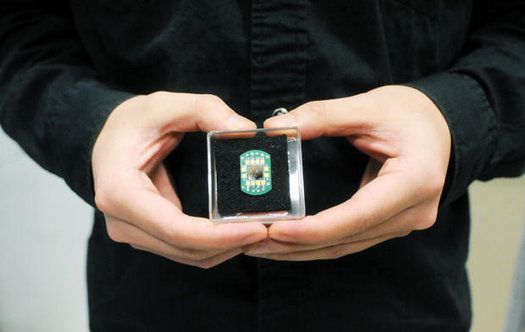
A new study, published in the journal Science, details how scientists have created a tiny, fully functional electronic device capable of vanishing within their environment, like in the body or in water, once they are no longer needed or useful. There are already implants that dispense drugs or provide electrical stimulation but they do not dissolve.
The latest creation is an early step in a technology that may benefit not only medicine, like enabling the development of medical implants that don't need to be surgically removed or the risk of long-term side effects, but also electronic waste disposal.
Researchers led by John Rogers, a materials scientist at the University of Illinois at Urbana-Champaign, Fiorenzo Omenetto, a biomedical engineer at Tufts University in Medford, Massachusetts, and Youggang Huang of Northwestern University have already designed an imaging system that monitors tissue from inside a mouse, a thermal patch that prevents infection after a surgical site is stitched up, solar cells as well as strain and temperature sensors.
While most electronic devices are built to last, the latest device is made up of silicon and a tiny magnesium oxide circuit encapsulated in a protective layer of silk that can easily and harmlessly be absorbed by body fluids.
"We refer to this type of technology as transient electronics," Rogers, a professor of engineering at the University of Illinois, said in a statement. "From the earliest days of the electronics industry, a key design goal has been to build devices that last forever -- with completely stable performance. But if you think about the opposite possibility -- devices that are engineered to physically disappear in a controlled and programmed manner -- then other, completely different kinds of application opportunities open up."
The researchers, who have already developed "electronic tattoos," sensors that bend and stretch with the skin, say that they can now make just about any kind of dissolving high-performance electronic or optical device using transient electronics, according to Nature News.
In the latest experiment, researchers had created tiny computer chip-like devices that were designed to generate heat to kill germs and fight infection after surgery. They found that the devices worked in mice for more than a week until their silk coating dissolved enough for bodily fluids to break down key parts of the device. They found that after three weeks, the tiny gadgets had completely vanished.
The latest technology could also be used to develop cell phones and other common gadgets that dissolve after a number of years rather than ending up in landfills, according to researchers.
"These electronics are there when you need them, and after they've served their purpose they disappear. This is a completely new concept," Huang said.
Researchers led by John Rogers, a materials scientist at the University of Illinois at Urbana-Champaign, Fiorenzo Omenetto, a biomedical engineer at Tufts University in Medford, Massachusetts, and Youggang Huang of Northwestern University have already designed an imaging system that monitors tissue from inside a mouse, a thermal patch that prevents infection after a surgical site is stitched up, solar cells as well as strain and temperature sensors.
While most electronic devices are built to last, the latest device is made up of silicon and a tiny magnesium oxide circuit encapsulated in a protective layer of silk that can easily and harmlessly be absorbed by body fluids.
"We refer to this type of technology as transient electronics," Rogers, a professor of engineering at the University of Illinois, said in a statement. "From the earliest days of the electronics industry, a key design goal has been to build devices that last forever -- with completely stable performance. But if you think about the opposite possibility -- devices that are engineered to physically disappear in a controlled and programmed manner -- then other, completely different kinds of application opportunities open up."
The researchers, who have already developed "electronic tattoos," sensors that bend and stretch with the skin, say that they can now make just about any kind of dissolving high-performance electronic or optical device using transient electronics, according to Nature News.
In the latest experiment, researchers had created tiny computer chip-like devices that were designed to generate heat to kill germs and fight infection after surgery. They found that the devices worked in mice for more than a week until their silk coating dissolved enough for bodily fluids to break down key parts of the device. They found that after three weeks, the tiny gadgets had completely vanished.
The latest technology could also be used to develop cell phones and other common gadgets that dissolve after a number of years rather than ending up in landfills, according to researchers.
"These electronics are there when you need them, and after they've served their purpose they disappear. This is a completely new concept," Huang said.
Source...
Lost Egyptian pyramids found ... by Google?
Category: Ciencia , Google , News , Noticia , Science , Technology , Tecnología
Images from Google Earth reveal what appear to be two long-lost pyramid complexes.
Two possible pyramid complexes might have been found in Egypt, according to a Google Earth satellite imagery survey.
Located about 90 miles apart, the sites contain unusual grouping of mounds with intriguing features and orientations, said satellite archaeology researcher Angela Micol of Maiden, N.C.
One site in Upper Egypt, just 12 miles from the city of Abu Sidhum along the Nile, features four mounds each with a larger, triangular-shaped plateau.
The two larger mounds at this site are approximately 250 feet in width, with two smaller mounds approximately 100 feet in width.
NEWS: Egyptian Pyramids Found With NASA Satellite
Located about 90 miles apart, the sites contain unusual grouping of mounds with intriguing features and orientations, said satellite archaeology researcher Angela Micol of Maiden, N.C.
One site in Upper Egypt, just 12 miles from the city of Abu Sidhum along the Nile, features four mounds each with a larger, triangular-shaped plateau.
The two larger mounds at this site are approximately 250 feet in width, with two smaller mounds approximately 100 feet in width.
NEWS: Egyptian Pyramids Found With NASA Satellite
The site complex is arranged in a very clear formation with the large mound extending a width of approximately 620 feet -- almost three times the size of the Great Pyramid.
"Upon closer examination of the formation, this mound appears to have a very flat top and a curiously symmetrical triangular shape that has been heavily eroded with time," Micol wrote in her website Google Earth Anomalies.
Intriguingly, when zooming in on the top of the triangular formation, two circular, 20-foot-wide features appear almost in the very center of the triangle.
Some 90 miles north near the Fayoum oasis, the second possible pyramid complex contains a four-sided, truncated mound that is approximately 150 feet wide.
ANALYSIS: Satellite Views Reveal Early Human Settlements
"It has a distinct square center which is very unusual for a mound of this size and it almost seems pyramidal when seen from above," Micol wrote.
Located just 1.5 miles south east of the ancient town of Dimai, the site also contains three smaller mounds in a very clear formation, "similar to the diagonal alignment of the Giza Plateau pyramids," Micol stated in a press release.
"The color of the mounds is dark and similar to the material composition of Dimai's walls which are made of mudbrick and stone," the researcher wrote.
HOWSTUFFWORKS: Building the Pyramids
Founded in the third century B.C. under the Ptolemaic king Ptolemy II Philadelphus (309 B.C.–246 B.C.), Dimai was built on top of an earlier neolithic settlement.
Also known as Dimeh al-Siba, Dimeh of the Lions, the town is surrounded by a mudbrick wall that stretches up to 32 feet high and 16 feet thick, and features at its center a ruined stone temple dedicated to the crocodile god Soknopaios.
Indeed, the town's Greek name, Soknopaiou Nesos, means "Island of Soknopaios."
Well known to scholars for the amount of papyri and other inscribed material found among its ruins, Dimai reached its peak during the first and second century A.D. thanks to a major trade route. It was abandoned during the mid-third century A.D.
According to Micol, both sites have been verified as undiscovered by Egyptologist and pyramid expert Nabil Selim, whose findings include the pyramid called Sinki at Abydos and the Dry Moat surrounding the Step pyramid complex at Saqqara.
Selim found that the smaller 100-foot mounds at the site near Abu Sidhum are a similar size as the 13th Dynasty Egyptian pyramids, if a square base can be discovered.
BIG PIC: Man Etches Name in Sand, Visible from Space
"The images speak for themselves. It's very obvious what the sites may contain but field research is needed to verify they are, in fact, pyramids," Micol said.
The researcher has previously located several possible archaeological sites with Google Earth, including a potential underwater city off the coast of the Yucatan peninsula.
She believes the use of infrared imagery will allow scientists to see the extent of the complexes in greater detail.
The sites have been sent to Egyptologists and researchers for further investigation and "ground truthing," she said.
Photos: The site near Abu Sidhum contains four mounds with a larger, triangular-shaped plateau. Credit: Angela Micol;
-- Enhanced image of the 150 foot wide, four-sided mound near the ancient town of Dimai. Credit: Angela Micol;
-- The site also contains three smaller mounds in a formation similar to the diagonal alignment of the Giza Plateau pyramids. Credit: Angela Micol.
Source...
9. The Most Flammable Substance
A lot of things burn with astounding intensity; Styrofoam, napalm, marshmallows are just the beginning. But what if there was a material that could set sand on fire? Okay, so clearly that was a loaded question, but it was a necessary set-up. Chlorine triflouride has the dubious honor of being terrifyingly flammable, to the point that history’s evil boy-scouts, the Nazis, deemed it too dangerous to work with. When people who consider genocide their life’s goal don’t want to use something because it is too deadly, it bears treating it with some caution. There is a story that a ton of the stuff was spilled once and caught fire, and it burned through 12 inches of concrete and another meter of sand and gravel before going out. I hate to say it, but in this case, the Nazi’s were right.
8. The Most Toxic Poison
Quick, what’s the last thing you would want to inject into your face? Aside from something that burns through concrete, and maybe the world’s worst acid (coming soon), I would think “The world’s deadliest poison” would be in the top 3 with them. Not so, though, in the medical community; you’ve all heard of Botox, no doubt, and “deadliest poison” is it’s main claim to fame. Botox uses botulinum toxin, produced by the bacteria Clostridium botulinum, and it is so deadly, an amount equal to a grain of salt is enough to kill a 200 lb man. In fact, they even suggest that it would only take 4kg, properly dispersed, to kill every last person on earth. Maybe those crows feet around your eyes would be better treated with an angry rattlesnake….
7. The Hottest Substance Ever
8. The Most Toxic Poison
Quick, what’s the last thing you would want to inject into your face? Aside from something that burns through concrete, and maybe the world’s worst acid (coming soon), I would think “The world’s deadliest poison” would be in the top 3 with them. Not so, though, in the medical community; you’ve all heard of Botox, no doubt, and “deadliest poison” is it’s main claim to fame. Botox uses botulinum toxin, produced by the bacteria Clostridium botulinum, and it is so deadly, an amount equal to a grain of salt is enough to kill a 200 lb man. In fact, they even suggest that it would only take 4kg, properly dispersed, to kill every last person on earth. Maybe those crows feet around your eyes would be better treated with an angry rattlesnake….
7. The Hottest Substance Ever
There are few things known to man hotter than the interior of a freshly microwaved Hot Pocket, but this stuff manages to break even that record. Created by smashing gold atoms together at nearly the speed of light, it’s called a quark-gluon soup, and it reaches a balmy 4 trillion degrees Celsius, a mere 250,000 times hotter than the inside of the sun. The amount of energy released in the collision was sufficient to melt protons and neutrons, which in itself could be featured on a list of things you never even knew were possible. Scientists think this substance could give us an idea of what the birth of our universe was like, so it’s good to see they aren’t just creating tiny supernovas for the fun of it. However, the really good news is that the soup was only a trillionth of a centimeter across, and only lasted for a trillionth of a trillionth of a second.
6. Most Acidic Acid
Acid is scary stuff; they gave one of the scariest movie monsters ever acid blood to make it scarier than just a simple killing machine (the Alien), so it’s pretty ingrained in our psyche that getting dissolved is bad. If the Aliens had been filled with fluoroantimonic acid, they not only would have probably fallen through the floor until they hit dirt, the vapors given off by their dying bodies would have killed everyone around them. It is 21019 times more powerful than sulphuric acid, and can even eat through glass. And it explodes when exposed to water. And when it is reacting, it gives off poisonous fumes that can kill everyone in a room. Maybe we should move on from this one…
5. The Most Explosive Expolosive
6. Most Acidic Acid
Acid is scary stuff; they gave one of the scariest movie monsters ever acid blood to make it scarier than just a simple killing machine (the Alien), so it’s pretty ingrained in our psyche that getting dissolved is bad. If the Aliens had been filled with fluoroantimonic acid, they not only would have probably fallen through the floor until they hit dirt, the vapors given off by their dying bodies would have killed everyone around them. It is 21019 times more powerful than sulphuric acid, and can even eat through glass. And it explodes when exposed to water. And when it is reacting, it gives off poisonous fumes that can kill everyone in a room. Maybe we should move on from this one…
5. The Most Explosive Expolosive
Speaking of radiation, it’s worth noting that the glowing green rods of “plutonium” on the Simpsons are completely fictional. Just because something is radioactive does not mean it glows. I mention that because Polonium-210 is so radioactive, it glows blue. A former soviet spy, Alexander Litvinenko, was duped into consuming some without his knowledge, and he died of cancer shortly thereafter. This is not that kind of thing you ever want to mess with; the glow is caused by the air around it being excited by the radiation, and it can actually heat objects nearby. If the fact that something highly radioactive gives off heat, keep in mind that when we usually think “radiation”, we are thinking of things like a nuclear reactor or explosion, where an actual fission reaction is happening. This is just your run of the mill loss of ionized particles, not a runaway splitting of atoms.
3. The Hardest Substance
If Magneto was a small black lump, that would be him. The substance, developed in 2010 out of iron and nitrogen, is 18% more magnetic than the previous record holder, and is so powerful, it has forced scientists to revisit how magnetism works. The man who discovered the substance has taken great pains to ensure that his work can be reproduced by other scientists, because a similar compound was reported developed in Japan back in 1996, but other physicists could not replicate it, so it was never officially accepted. No word on whether Japanese physicists have to commit Sepuku under these circumstances. If it can be reproduced, it could spell a new age of efficient electronics and magnetic engines, maybe even powered by number 10.
1. The Most Super Superfluid
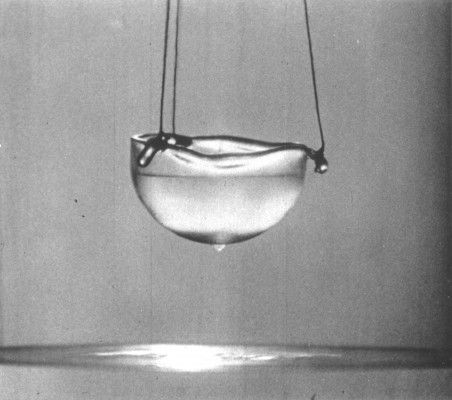
Superfluidity is a state of matter (like solid or gaseous) that occurs at extremely low temperatures, has high thermal conductivity (every ounce of it is always exactly the same temperature), and no viscosity. Helium 2 is the “most” example of this. A cup of He2 will spontaneously flow up and out of a container, as if it just decided to leave. It also seeps right through otherwise solid materials because its complete lack of friction allows it to flow through otherwise invisible holes that would not allow regular helium (or water for that matter) to flow through. He2 did not wind up at number 1 just because of its ability to act like it has a mind of its own, though, it is also the most efficient thermal conductor on earth; several hundred times that of copper. Heat moves so fast through Helium 2 that it moves in waves, like sound (and is fact known as “second sound”), rather than dispersion, where it simply transfers from one molecule to another. Incidentally, the forces governing He2’s ability to crawl walls is called “third sound”. You can’t get much more extreme than a substance that required the definitions of 2 new types of sound.
1. The Most Super Superfluid
Superfluidity is a state of matter (like solid or gaseous) that occurs at extremely low temperatures, has high thermal conductivity (every ounce of it is always exactly the same temperature), and no viscosity. Helium 2 is the “most” example of this. A cup of He2 will spontaneously flow up and out of a container, as if it just decided to leave. It also seeps right through otherwise solid materials because its complete lack of friction allows it to flow through otherwise invisible holes that would not allow regular helium (or water for that matter) to flow through. He2 did not wind up at number 1 just because of its ability to act like it has a mind of its own, though, it is also the most efficient thermal conductor on earth; several hundred times that of copper. Heat moves so fast through Helium 2 that it moves in waves, like sound (and is fact known as “second sound”), rather than dispersion, where it simply transfers from one molecule to another. Incidentally, the forces governing He2’s ability to crawl walls is called “third sound”. You can’t get much more extreme than a substance that required the definitions of 2 new types of sound.
Last year, using the exoplanets discovered by the Kepler space telescope as a guide, astronomers took a statistical stab at estimating the number of exoplanets that exist in our galaxy. They came up with at least 50 billion alien worlds.
Today, astronomers from the Space Telescope Science Institute (STScI) in Baltimore, Md., and the PLANET (Probing Lensing Anomalies NETwork) collaboration have taken their own stab at the "galactic exoplanetary estimate" and think there are at least 100 billion worlds knocking around the Milky Way.
Why has the estimate doubled? The key difference here are the methods used to detect alien worlds orbiting distant stars.
NEWS: Two More Planets With Twin Stars Found
The Kepler space telescope watches the same patch of sky -- containing around 100,000 stars -- and waits for slight "dips" in starlight brightness. This dip occurs when an exoplanet passes in front of its parent star, thereby blocking a tiny fraction of light from view.
This slight dimming effect is known as a "transit" and when four transits are detected by Kepler, the announcement of a confirmed exoplanet can be made.
The "transit method" has proven itself to be an excellent way of spotting exoplanets, but the method favors the detection of large exoplanets and exoplanets that orbit close to their stars. Pretty obvious really; the closer or the larger the exoplanet, the more starlight can be blocked and the bigger the "dip."
However, to arrive at their "galactic exoplanetary estimate" the PLANET team employed a rather different (and more random) exoplanet detection method known as "microlensing."
Microlensing depends on a lot of patience and a lot of luck, but given enough time and enough stars, exoplanets can be discovered this way.
From our perspective, as stars drift around the sky, occasionally one star will drift in front of another. The starlight from the more distant star may become bent around the foreground star by its gravity, causing the light from the background star to brighten for a short period of time.
NEWS: Rocky, Low-Mass World Discovered via Microlensing
The foreground star has basically acted as a magnifying lens, focusing the light from the background star for astronomers on Earth to observe. The more massive the star, the longer the brightening event.
This is where the clever bit comes in. Should the foreground star have an exoplanet (or a system of exoplanets) in orbit, its additional gravity will create another brightening event, thereby allowing astronomers on Earth to measure the exoplanet's mass and orbit.
Typically, the microlens brightening caused by the star will last about a month and the brightening caused by the presence of an exoplanet will only last a few hours.
Microlensing events are random occurrences and don't depend on star selection. Also, the method can detect exoplanets as small as Mercury and exoplanets orbiting as far from their host star as Saturn orbits the sun. Kepler's transit detection method favors the detection of worlds orbiting close to their stars, whereas microlensing has no such restriction.
So, when the PLANET collaboration detected 40 microlensing events, and noted that three contained exoplanets, they could do a statistical analysis to estimate the number of stars that have exoplanets in our galaxy.
From this analysis, the PLANET team made a rough estimate of 100 billion exoplanets living in our galaxy. Additionally, they found that one-in-six stars host a Jupiter-mass exoplanet, half the stars in the Milky Way have Neptune-mass exoplanets and two-thirds of the stars have Earth-mass worlds.
Interestingly, this result points to least 1,500 exoplanets within 50 light-years from the solar system.
As already uncovered by the Kepler science team, smaller worlds appear to dominate our galaxy -- the PLANET collaboration supports this idea.
NEWS: Milky Way Could Have Over 100 Million Solar System Analogs
"This means, statistically, every star in the galaxy is likely to have at least one planet, and probably more," said Kailash Sahu, STScI astronomer and co-founder of PLANET.
"Results from the three main techniques of planet detection (radial velocity, transit and microlensing techniques) are rapidly converging to a common result: Not only are planets common in the galaxy, but there are more small planets than large ones," said Stephen Kane, of NASA's Exoplanet Science Institute at the California Institute of Technology, Pasadena, Calif. "This is encouraging news for investigations into habitable planets."
Of course, this statistical analysis is just a projection and based on the very thin knowledge we have about the real distribution of alien worlds throughout the Milky Way. The number could be wildly different. But the more we look, the more exoplanets we discover and the more we realize that our solar system is not unique.
But is Earth unique? Unfortunately, we cannot fully understand the atmospheres of these distant worlds, and so cannot reveal if any are any true "Earth analogs." But with enough time, patience and scientific ingenuity, the answer may not be too far away.
Source...
Today, astronomers from the Space Telescope Science Institute (STScI) in Baltimore, Md., and the PLANET (Probing Lensing Anomalies NETwork) collaboration have taken their own stab at the "galactic exoplanetary estimate" and think there are at least 100 billion worlds knocking around the Milky Way.
Why has the estimate doubled? The key difference here are the methods used to detect alien worlds orbiting distant stars.
NEWS: Two More Planets With Twin Stars Found
The Kepler space telescope watches the same patch of sky -- containing around 100,000 stars -- and waits for slight "dips" in starlight brightness. This dip occurs when an exoplanet passes in front of its parent star, thereby blocking a tiny fraction of light from view.
This slight dimming effect is known as a "transit" and when four transits are detected by Kepler, the announcement of a confirmed exoplanet can be made.
The "transit method" has proven itself to be an excellent way of spotting exoplanets, but the method favors the detection of large exoplanets and exoplanets that orbit close to their stars. Pretty obvious really; the closer or the larger the exoplanet, the more starlight can be blocked and the bigger the "dip."
However, to arrive at their "galactic exoplanetary estimate" the PLANET team employed a rather different (and more random) exoplanet detection method known as "microlensing."
Microlensing depends on a lot of patience and a lot of luck, but given enough time and enough stars, exoplanets can be discovered this way.
From our perspective, as stars drift around the sky, occasionally one star will drift in front of another. The starlight from the more distant star may become bent around the foreground star by its gravity, causing the light from the background star to brighten for a short period of time.
NEWS: Rocky, Low-Mass World Discovered via Microlensing
The foreground star has basically acted as a magnifying lens, focusing the light from the background star for astronomers on Earth to observe. The more massive the star, the longer the brightening event.
This is where the clever bit comes in. Should the foreground star have an exoplanet (or a system of exoplanets) in orbit, its additional gravity will create another brightening event, thereby allowing astronomers on Earth to measure the exoplanet's mass and orbit.
Typically, the microlens brightening caused by the star will last about a month and the brightening caused by the presence of an exoplanet will only last a few hours.
Microlensing events are random occurrences and don't depend on star selection. Also, the method can detect exoplanets as small as Mercury and exoplanets orbiting as far from their host star as Saturn orbits the sun. Kepler's transit detection method favors the detection of worlds orbiting close to their stars, whereas microlensing has no such restriction.
So, when the PLANET collaboration detected 40 microlensing events, and noted that three contained exoplanets, they could do a statistical analysis to estimate the number of stars that have exoplanets in our galaxy.
From this analysis, the PLANET team made a rough estimate of 100 billion exoplanets living in our galaxy. Additionally, they found that one-in-six stars host a Jupiter-mass exoplanet, half the stars in the Milky Way have Neptune-mass exoplanets and two-thirds of the stars have Earth-mass worlds.
Interestingly, this result points to least 1,500 exoplanets within 50 light-years from the solar system.
As already uncovered by the Kepler science team, smaller worlds appear to dominate our galaxy -- the PLANET collaboration supports this idea.
NEWS: Milky Way Could Have Over 100 Million Solar System Analogs
"This means, statistically, every star in the galaxy is likely to have at least one planet, and probably more," said Kailash Sahu, STScI astronomer and co-founder of PLANET.
"Results from the three main techniques of planet detection (radial velocity, transit and microlensing techniques) are rapidly converging to a common result: Not only are planets common in the galaxy, but there are more small planets than large ones," said Stephen Kane, of NASA's Exoplanet Science Institute at the California Institute of Technology, Pasadena, Calif. "This is encouraging news for investigations into habitable planets."
Of course, this statistical analysis is just a projection and based on the very thin knowledge we have about the real distribution of alien worlds throughout the Milky Way. The number could be wildly different. But the more we look, the more exoplanets we discover and the more we realize that our solar system is not unique.
But is Earth unique? Unfortunately, we cannot fully understand the atmospheres of these distant worlds, and so cannot reveal if any are any true "Earth analogs." But with enough time, patience and scientific ingenuity, the answer may not be too far away.
Source...
THE GIST
The Kepler telescope found a Saturn-sized gas giant orbiting a pair of stars four months ago.
The discovery suggests there are several million similar systems in our galaxy.
The planets are close to their parent stars' so-called "habitable zones" where liquid water could exist on the surface -- if they had a surface.
------------------------------------------------------------------------------------------------------------
Fresh on the heels of the discovery of a planet orbiting two parent stars comes the finding that far from being a fluke, such systems are common throughout the galaxy.
------------------------------------------------------------------------------------------------------------
Fresh on the heels of the discovery of a planet orbiting two parent stars comes the finding that far from being a fluke, such systems are common throughout the galaxy.
Until four months ago, the idea of a planet with two suns in its sky was relegated to the realm of science fiction, such as Tatooine, the home world of Star Wars' hero Luke Skywalker.
Then came a surprising find from a team of scientists using the Kepler telescope of a planet called Kepler-16 b, a Saturn-sized gas giant orbiting a pair of stars about 200 light years from Earth.
NEWS: Weird Exoplanet Discovered Orbiting Two Stars
Now, scientists have found two more planets circling twin parent stars, a discovery that indicates such systems are not only possible, but highly probable throughout the galaxy.
Extrapolating from the research, which was presented Wednesday at the American Astronomical Society meeting in Austin, astronomers believe that several million of so-called "circumbinary planets" exist in the Milky Way.
"Kepler-16 b was interesting, but it was just one. We didn't know if it was normal or just a fluke," astronomer John Southworth, with Keele University in the United Kingdom, told Discovery News. "Now we have to start accounting for a large number of these things."
Then came a surprising find from a team of scientists using the Kepler telescope of a planet called Kepler-16 b, a Saturn-sized gas giant orbiting a pair of stars about 200 light years from Earth.
NEWS: Weird Exoplanet Discovered Orbiting Two Stars
Now, scientists have found two more planets circling twin parent stars, a discovery that indicates such systems are not only possible, but highly probable throughout the galaxy.
Extrapolating from the research, which was presented Wednesday at the American Astronomical Society meeting in Austin, astronomers believe that several million of so-called "circumbinary planets" exist in the Milky Way.
"Kepler-16 b was interesting, but it was just one. We didn't know if it was normal or just a fluke," astronomer John Southworth, with Keele University in the United Kingdom, told Discovery News. "Now we have to start accounting for a large number of these things."
The newly found planets, dubbed Kepler-34 b and Kepler-35 b, are both gas giants, similar to Saturn, circling close to their parent stars' "habitable zones" where liquid water could exist on a planet's surface. Liquid water is believed to be a key ingredient for life.
While neither planet is believed to have the solid body or the proper temperatures to support life, they may have life-friendlier moons.
Kepler-34 b orbits two sun-like stars every 289 days. Cousin planet Kepler-35 b circles a pair of smaller stars every 131 days. Scientists don't yet know if either or both systems sport sibling planets circling farther away from the parent star twins.
PHOTOS: Top Exoplanets for Alien Life
While neither planet is believed to have the solid body or the proper temperatures to support life, they may have life-friendlier moons.
Kepler-34 b orbits two sun-like stars every 289 days. Cousin planet Kepler-35 b circles a pair of smaller stars every 131 days. Scientists don't yet know if either or both systems sport sibling planets circling farther away from the parent star twins.
PHOTOS: Top Exoplanets for Alien Life
Kepler works by pointing at a fixed position in space, gathering light from about 155,000 target stars in the constellations Cygnus and Lyra. Scientists looks for minute and regular dips in the amount of light coming from the target stars which may be caused by planets passing by, relative to Kepler’s view.
A planet located the same distance from its parent star -- or stars -- as Earth is to the sun would take roughly 365 days to make one complete orbit. Planets positioned farther than Earth take longer to orbit. Scientists want data from at least three orbits before making a determination about what they are seeing.
"One of the neat things about all three systems (Kepler-16, Kepler-34 and Kepler-35), is that the planets are very close to the limit where if they were only a little bit closer to their stars, the gravitational forces from the stars would be chaotic and mess up the orbits and pretty quickly, the planet would be ejected out into deep space," San Diego State University astronomer William Welsh told Discovery News.
"There's a region where if you're too close to the star, the orbits are unstable and these planets are within 25 percent of that," he added.
"That's kind of a neat question: 'Why are they so close to this area of being unstable?' We don’t the answer to that, but the answer is going to tell us something about the way planets form, or the way their orbits evolve in time," Welsh said.
A planet located the same distance from its parent star -- or stars -- as Earth is to the sun would take roughly 365 days to make one complete orbit. Planets positioned farther than Earth take longer to orbit. Scientists want data from at least three orbits before making a determination about what they are seeing.
"One of the neat things about all three systems (Kepler-16, Kepler-34 and Kepler-35), is that the planets are very close to the limit where if they were only a little bit closer to their stars, the gravitational forces from the stars would be chaotic and mess up the orbits and pretty quickly, the planet would be ejected out into deep space," San Diego State University astronomer William Welsh told Discovery News.
"There's a region where if you're too close to the star, the orbits are unstable and these planets are within 25 percent of that," he added.
"That's kind of a neat question: 'Why are they so close to this area of being unstable?' We don’t the answer to that, but the answer is going to tell us something about the way planets form, or the way their orbits evolve in time," Welsh said.
Suscribirse a:
Entradas (Atom)
(C) All Rights Reserved. El hongo escribe | Free blogger templates Designed by SkinPress.com